
|
Getting your Trinity Audio player ready...
|
PRESS RELEASE
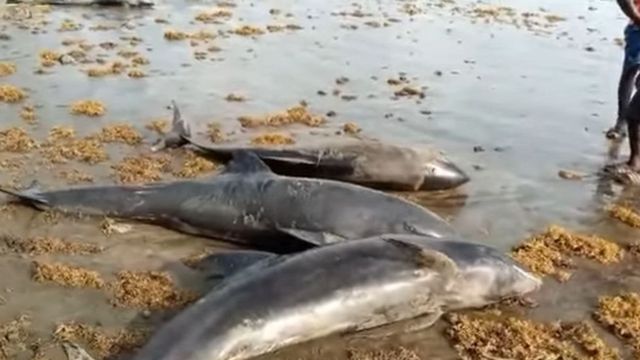
On 2nd April 2021, news broke out on various electronic and social media platforms of several dead fishes and dolphins at some beaches along the coast of Ghana.
Since then, there have been some speculations about the cause of the incident leading to a directive for selected state institutions to investigate the unusual occurrence.
As scientists and researchers of a public institution, it behoves upon us to provide an understanding of the situation, within the purview of information at our disposal.
The purpose of this press release is to share with the Ghanaian public our preliminary findings of our investigations as a contribution to the ongoing discourse on the matter.
The University of Ghana’s Department of Marine and Fisheries Sciences carried out a preliminary scientific assessment of the situation.
Results from water quality analyses showed that most parameters required for life in the ocean were within acceptable limits, with the exception of Chemical Oxygen Demand (COD), which was significantly higher than expected.
This oxygen demand would most likely create a condition of stress on living organisms that depend on dissolved oxygen in the water body.
It is interesting to note that a few days to the fish kill, there was a sudden drop in sea surface temperature as observed from satellite imageries over the coast from Cote d’Ivoire to Togo.
This is most likely an indication of upwelled water from the bottom of the ocean, probably carrying low oxygen concentration.
At this stage, we do not have any data on what triggered these incidents. It requires that an ocean monitoring programme is established as a matter of urgency.
With regards to the possibility of an incidence of harmful algal bloom, we did not observe phytoplankton abundance to be at the level to cause a bloom.
It must be noted that species of phytoplankton that potentially cause blooms resulting in fish kills have always been in our waters.
It is their higher than normal levels that could lead to a situation of harmful bloom. Oceanographic processes sometimes take time to become observable and we will continue to monitor the situation.
The fish species that were killed were both demersal (bottom-dwellers), and pelagic (above the bottom dwellers); of both small and large sizes.
We confirm the identification of the marine mammals found dead along the coast as the melon-headed whale (Peponocephala electrica), a dolphin belonging to the Cetacean order.
We take this opportunity to reiterate our call for the nation to acquire a research vessel that would help with carrying out regular monitoring of our coastal waters.
We depend very much on marine living and non-living resources for a significant portion of our national wealth. It is implicit that we protect this asset through regular monitoring so as to avert any future calamity.
The impact of global climate change and its vulnerability is real and coastal states are the worst to be affected.
We will do our best with the limited resources at our disposal to continue with our investigation and update the public in due course.
Head, Department of Marine and Fisheries Sciences
University of Ghana
Email:mafs@ug.edu


