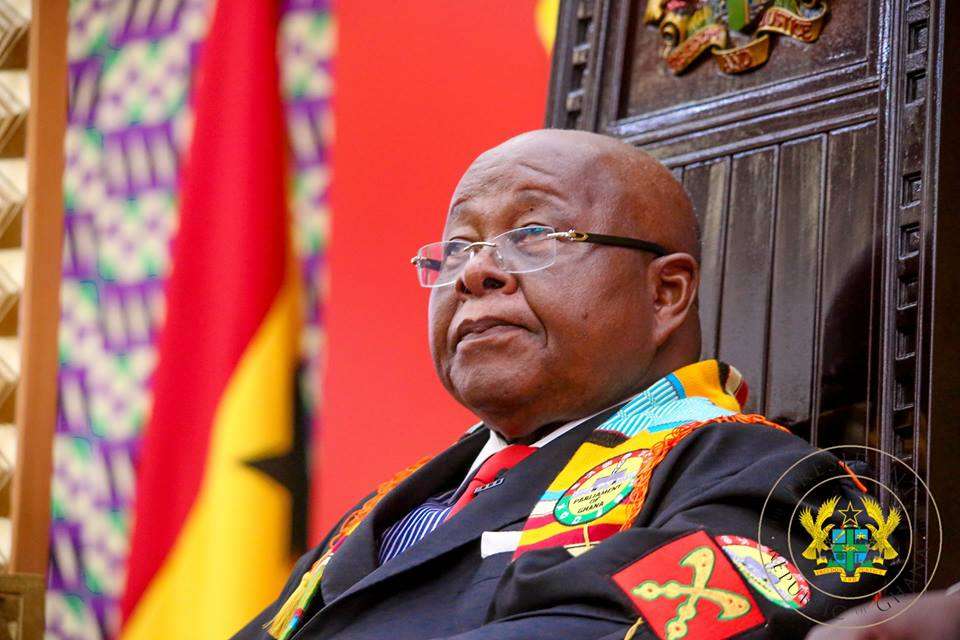
Speaker of Parliament, the Rt. Hon. Professor Aaron Michael Oquaye has inaugurated a Four-Member Advisory Committee to the Parliamentary Training Institute (PTI) to cater for the training needs of Members of Parliament and Staff of the Parliamentary Service.
The Institute would also serve as a centre of legislative excellence, train newly elected Members of Parliament (MPs), offer periodic training to continuing MPs and also Staff of the Metropolitan, Municipal, and District Assemblies (MMDA’s) as well as MPs and Staff of sister African Parliaments.
The Committee comprised of Dr. Rasheed Draman, Director of the African Center for Parliamentary Affairs and Dr. Maame A.A. Gyekye-Jandoh, Head of Political Science Department of University of Ghana, Legon.
Professor Stephen Addei, former Director-General and Rector of the Ghana Institute of Management and Public Administration (GIMPA) and currently the Chairperson of the National Development Planning Commission (NDPC) and Professor Henry Kwasi Prempeh, the Executive Director of the Center for Democratic Governance-Ghana (CDD) complete membership of the Committee.
Also READ: Education without quality is useless – Mahama
The Committee whose functions are similar to those of a University Council has the ultimate power and authority in recommending standards for the achievement of the Institute’s goals as well as directing the highest academic standards of teaching, learning and research.
The Speaker in his welcome address last Friday explained that the idea of establishing the Advisory Committee was to have an Advisory Board which would direct the PTI with regards to its intellectual goals.
This, he said, would enable it to continue to be attached to academia and raise its global status and conceptualise the framework for the realisation of its objectives.
He expressed hope the Committee will advise on the selection of the Director and the various positions akin to a Registrar of a University or a University College and other allied issues so that there would be a strong academic approach to all activities that the Institute is engaged in.
Prof. Mike Oquaye stressed on research and lamented that research work in the country is not good enough and grieved that even doctoral students find it difficult to proceed with research on aspects of Parliament efficaciously due to inadequate documentation.
He was optimistic that products of the Institute would contribute effectively to national development while the Institute will also serve both as a Resource Centre and Centre of Excellence for students and researchers from the various research institutions and the universities.
The Speaker said, “Ghana can boast of world-class universities and think-tanks with international recognition such as University of Ghana, GIMPA, Kwame Nkrumah University of Science and Technology (KNUST), the Institute of Economic Affairs, Ghana (IEA) and CDD-Ghana among the many reputable institutions of higher learning.”
He, therefore, urged the Committee to help identify the appropriate affiliate university or institution among these established universities and think-tanks because certificates or degrees whether Diplomas, Bachelors, Masters, Postgraduate, Doctor of Philosophy without a linkage are of no use.
He gave the assurance that the Institute’s doors would be opened to everybody, home and abroad, who is interested in parliamentary or legislative and governance studies, to develop his or her potential through the Institute’s rich source of political analysis and administration.
The Parliamentary Service Board (PSB), he promised, will work closely with the Committee and give it all the needed cooperation and stressed that the Board was not going to set marching orders or interfere with activities of the Advisory Board.
He expressed his regret that Parliament is the institution that ceases to exist during coup d’états and therefore gave the assurance that the PTI will offer the highest standard of educational exposure to staff of the Service in a well-resourced intellectual manner and award them accredited degrees so that when they leave Parliament, they can also take up some positions anywhere.
Majority Leader Hon. Osei Kytei-Mensah-Bonsu, in his remarks, acknowledged that research has indicated that Parliament is recognised as the weakest among the three arms of government with continuous decline of the quality of work and debate in the House over the years since 1993.
He however hinted that the Institute would be used as a vehicle to reposition Parliament and to build the capacity of Members and also assist in building the capacity of the MMDCEs as well as those at the lower levels of governance.
He tasked the Committee to design programmes to build capacity of Members in their responsibility of representation including the deliberative function of Parliament, information transmission, legislation and financial control oversight, which arguably, is the greatest function of Parliament.
The Minority Leader, Haruna Iddrisu, expressed his thanks and appreciation to the Advisory Committee for accepting the Speaker’s invitation and their role to help reform, resituate and redefine the PTI, which in his view, is more or less a bureau of parliamentary studies and training.
He expressed confidence the Committee can improve the standing of the PTI as an institution of academic excellence, recognising that so long as Ghana remains committed to its democratic path that it took, Parliament will remain undisputedly a relevant institution in the democratic process.
The Tamale South MP stressed further that given the manifold role of Parliament and its multifunctional dimension, the PTI would be critical in equipping not just Members of Parliament but Staff of the Parliamentary Service with the needed skills to make Parliament stronger, more transparent and more accountable.
He urged the Committee to look at what exists elsewhere such as Kenya and South Africa and replicate it at the PTI so as to generally improve the governance regime of the country and also enable the PTI, as a parliamentary training bureau, to build the capacity of MPs and Staff of the Service since they are contributing tremendously to good governance.
Mr. Rashid Draman, on behalf of the Committee, assured the Speaker of their cooperation and support for the honour and confidence imposed in them.
He noted that much of what would happen would depend upon who heads the Institute because oftentimes, it is the Chief Executive of an Institute that makes a difference.
He assured the Speaker that with his help the right person for the job would be found.