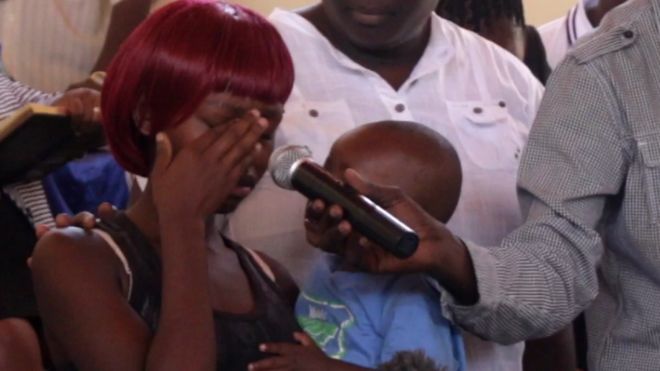
“I have lost two husbands in one year,” a tearful young woman, balancing a toddler on her side, told the crowded town hall meeting in Nairobi’s Kayole residential estate last month.
Others came forward to the microphone to tell similar stories about losing young relatives aged between 15 and 24.
The state prosecutor, top police officers and human rights activists, who were also at the rare gathering, listened as community leaders explain how these youngsters, suspected to be criminals, were profiled within various Facebook groups by “gangster hunters”.
“They profile them on Facebook, after one week or a month they shoot them, and put pictures of their dead bodies on Facebook,” Wilfred Olal from the Dandora Community Justice Centre told the meeting.
The posted photos, sometimes showing close-up shots of heads split open by bullets and eviscerated bodies, usually come with a warning that the same fate awaits other criminals. Some of the images are blurred by Facebook but a user can choose to un-blur them.
The Kayole residents say there are various Facebook groups, some public and some which are closed, that are updated with gruesome pictures almost every day.
Police tears
Duncan Omanga, a researcher at Moi University in Kenya, who has been monitoring such Facebook pages for three years, says that suspected police officers use anonymous digital personas to spy on their targets.
“The first unofficial police Facebook account appeared under the name Hessy wa Kayole [Hessy from Kayole].
“Hessy became the shadowy crime-hunter, the mystical lone ranger.”
With his legend spreading on social media, more Facebook accounts with names of gang hunters from other crime-ridden residential estates started to appear.
According to Mr Omanga, it seemed to be a deliberate strategy to give the impression of “police omnipresence and ‘state’ surveillance” in these areas of Nairobi.
Last November, former police chief Joseph Boinnet had said: “The person behind the Facebook accounts is not a police officer, but [a civilian] passionate about security matters.”
And the police’s Director of Criminal Investigations (DCI), George Kinoti, who shed tears whilst listening to some of the testimonies in Kayole, told the meeting that he had no knowledge of agents such as Hessy.
“I am saying no-one will ever cover for a police officer who kills under my watch.”
But his comments were drowned out by the crowd, with someone shouting: “They are on Facebook, even on Twitter.”
The meeting in Kayole was organised by the director of public prosecutions (DPP) after activists and residents said the police were not taking them seriously.
‘Fixing an appointment with God’
Mr Omanga’s research has found that in one month, an average of six suspected gangsters are profiled, details of their alleged crimes and areas of operation, and the kind of arms they are believed to own are published on various Facebook accounts and groups.
In the same period, between 10 and 12 police killings of suspected gangsters are published on a closed Facebook group called Nairobi Crime Free.
It has more than 300,000 members and has the slogan: “Forgiving a terrorist is left to God, but fixing their appointment with God is our responsibility”, along with the logo of an unidentified man wearing army combat uniform and a beret.